Both companies looking to buy out Noront Resources
Two Australian mining giants are doing their best to convince investors they have the superior deal, to takeover Noront Resources and its properties in the Ring of Fire.
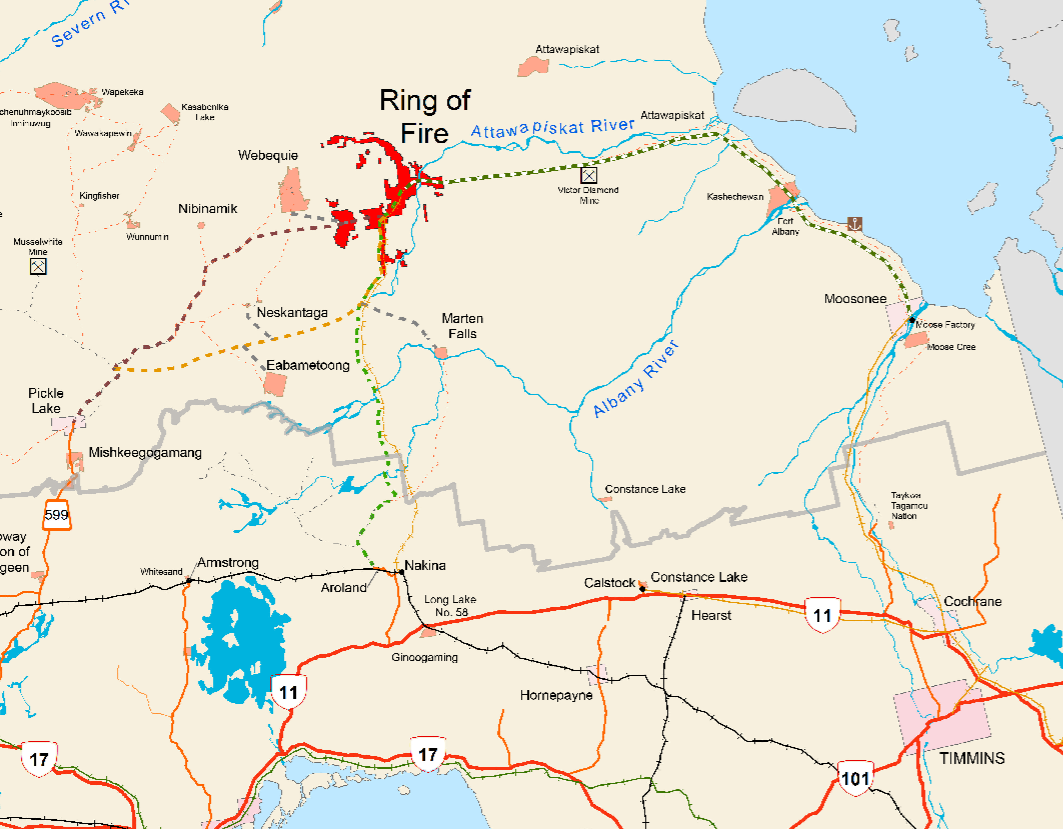
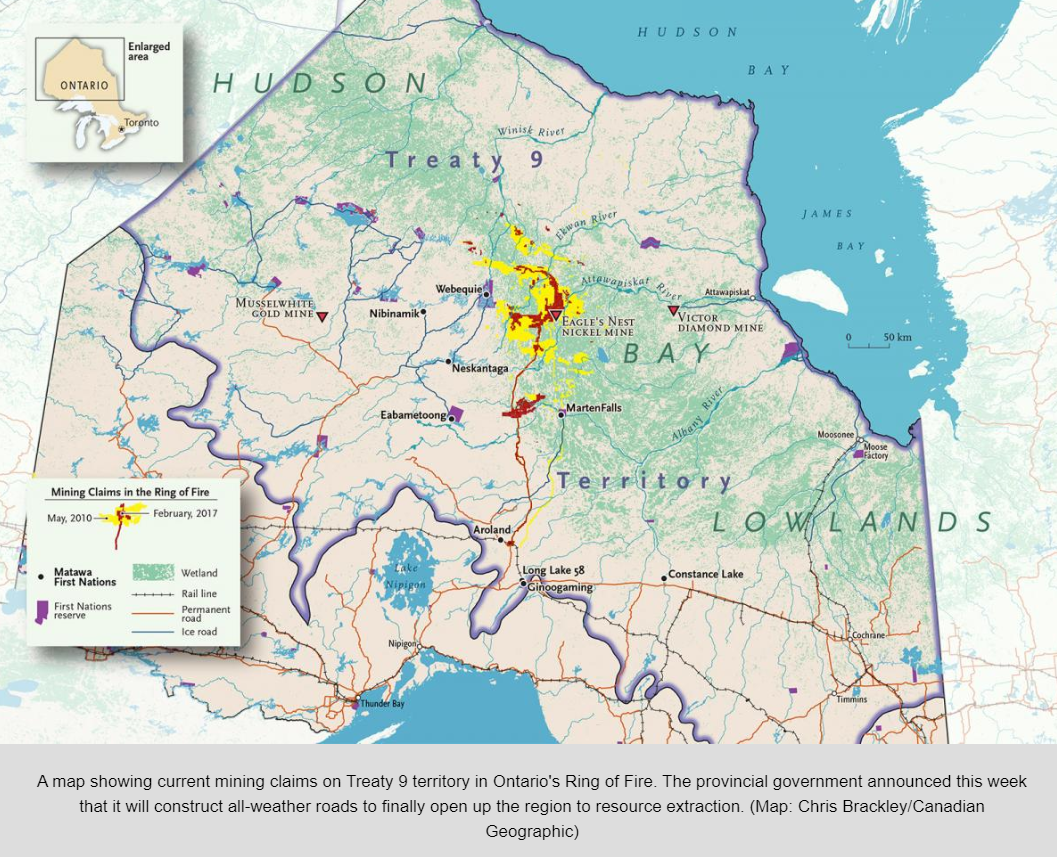
The mining area, about 500 kilometres northeast of Thunder Bay, Ont. has chromite, nickel and copper deposits. The two Australian companies, BHP and Wyloo Metals have been engaged in a battle to have the mineral rights in the remote mining area, to which one analyst compares to the long producing Sudbury basin.
The pessimism about the Ring of Fire is extraordinary. With two multi-billion-dollar Australian mining corporations fighting tooth and claw over this valuable mineral-rich camp, with one confirmed nickel/copper mine and one of the largest chromite deposits in the world, it is unjustified.
Many of the most prominent geologists in the country privately say that this is Sudbury Basin 2.0. For those outside the mining world, Sudbury’s polymetallic mineral deposits – nickel, copper, platinum group metals, cobalt, gold and silver – is the richest, multi-generational ore body in Canada and one of the most important integrated – mine, mill, smelter, refinery – mineral complexes in the world.
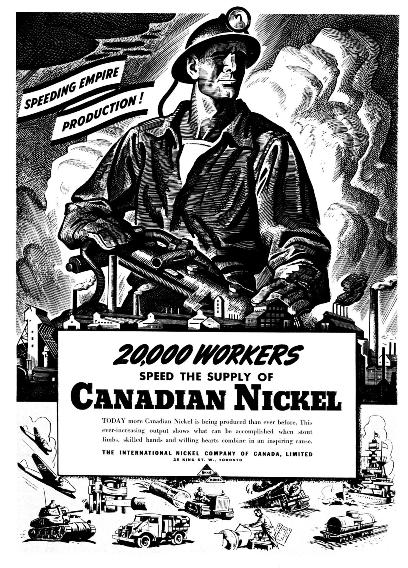
For much of the history of the last century, the city’s mines were the main source of nickel to the western world, a strategic metal vital for military weapons. In fact, the old Inco had long-standing connections to key people in the American Military Industrial Complex.
The thunder from down under has been reverberating through Ontario’s Ring of Fire mining camp – located roughly 500 kms northeast of Thunder Bay – as Australian mining giants BHP and Wyloo Metals are fighting a bruising bidding war for Noront Resources. The junior exploration company owns the Eagle’s Nest nickel/copper potential mine as well as extensive world-class chromite deposits and other mineral-rich promising ground.
BHP is the largest mining company in the world, whose current CEO, Mike Henry, is a Canadian, while Wyloo Metals is owned by Fortescue Metals, founded by mining billionaire Andrew ‘Twiggy’ Forrest, and is the world’s fourth largest iron ore miner.
“Noront’s ROF land package hosts some of the most prospective mineral deposits in the world. These deposits have the potential to become Canada’s next great mineral district, supporting the production of future-facing commodities for multiple generations”, claimed a Wyloo Metals news release in August.
The entry of multi-billion-dollar mining corporations signals a proverbial “game-change” in the stalled Ring of Fire mining camp. Noront Resource was a struggling junior company that did manage to consolidate almost half of the valuable mineral claims in the camp but did not have the funds to do significant further exploration or to build their existing mine. Newly established and well-funded explorer Juno Corporation is the largest claim holder who after extensive aerial geo-physics surveys that showcased promising anomalies, is hoping to add to future discoveries.
Please note that this article is from April 2014 – Stan Sudol
Located 500 kilometres northeast of Thunder Bay, the Ring of Fire mining camp contains billions worth of chromite — among the best deposits in the world — plus nickel, copper, platinum group elements, gold, zinc and vanadium.
In 2007, an interesting mix of six geologists and junior mining executives – Richard Nemis, Mac Watson, Neil Novack, John Harvey and Don Hoy — collectively found the most significant mineral discovery in Canada since the Sudbury Basin in 1883 and the Timmins gold camp in 1909.
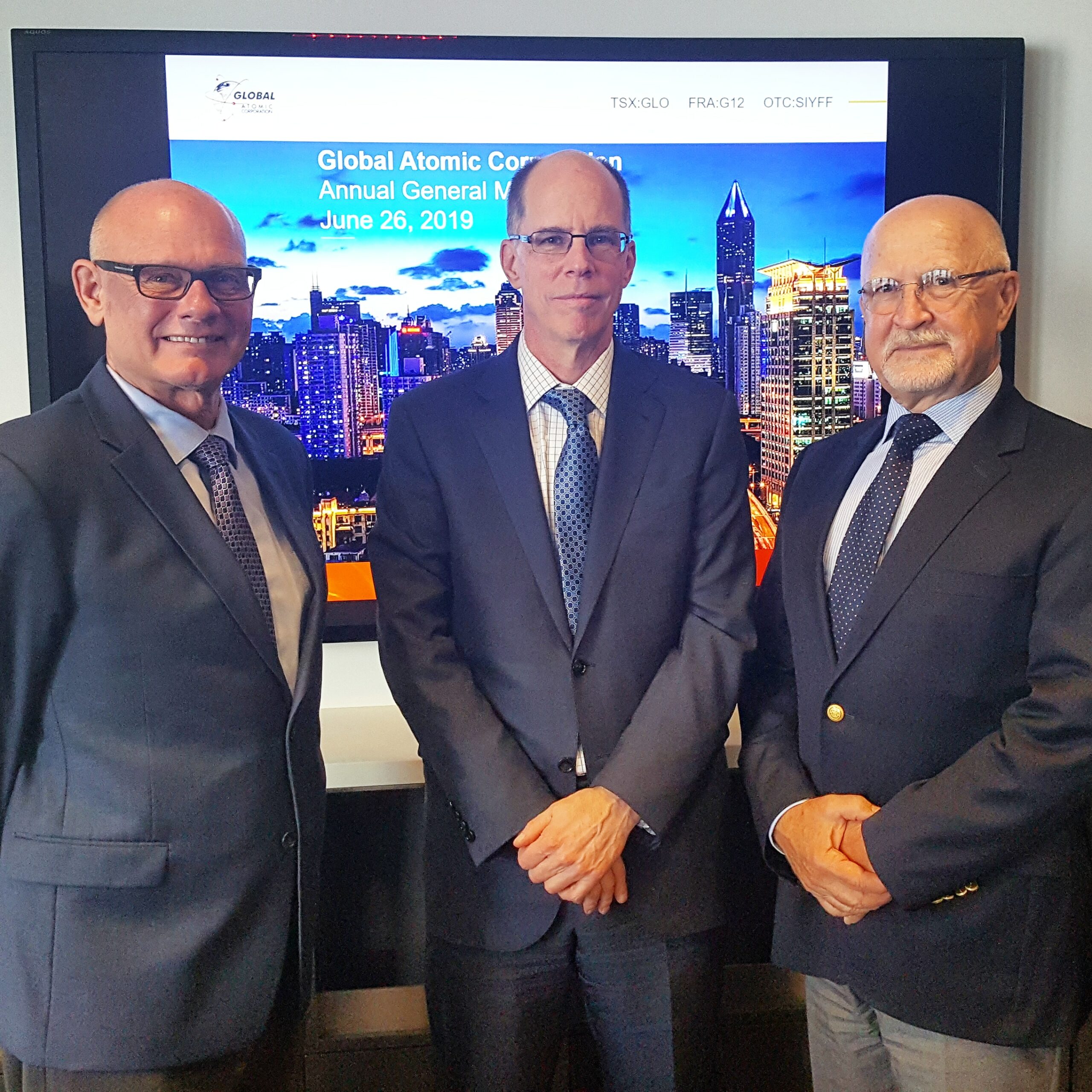
(LtoR) George A. Flach, P.Geo., Vice President, Exploration, Director; Tim Campbell, Vice President & Secretary and Stephen G. Roman, Chairman, President & CEO at the Global Atomic Corporation Annual General Meeting on June 26, 2019. (Photo by Stan Sudol)
https://www.northernminer.com/
“IL EST MORT! He is dead!” At least that was the verdict of five French doctors who were on their way to a medical convention on the Paris to London Eurostar train in 2014, when they briefly examined “the body” of Stephen G. Roman, Global Atomic’s (TSX: GLO; US-OTC: GATF) founder, chairman and CEO.
“I was on my way to meetings in London after visiting our uranium properties in the Republic of Niger, West Africa, just north of Ghana,” Roman recounts. “I had not been feeling very well after I ate a meal before our roughly five-hour plane flight from Niamey to Paris, but I thought I would persevere. Just after being served dinner on the Eurostar, I violently vomited and passed out falling to the floor of the train.”
Luckily, on further examination, a nurse found his pulse and both Roman and George Flach, Global Atomic’s vice president of exploration, were evacuated from the train at Lille, France via ambulance, and brought to a local hospital with all their luggage, where after a day of intensive antibiotic treatment for a highly contagious and virulent intestinal bacteria, Roman finally started to recover.
A recent commentary linking Neskantga’s water crisis to the proposed Ring of Fire mining development in Northwestern Ontario’s Far North made little sense except to further delay environmental assessments (EAs) for vital road infrastructure and enormous economic opportunities for the region’s impoverished Indigenous people.
First and foremost, the fact that Neskantaga – with an on-reserve population of slightly less than 300 people – has not had potable water for an astonishing 25-years is a national disgrace.
Almost 150 years ago, Canada was small little country of around five million people and was able to build the longest railroad in the world, at that time, from Ontario to British Columbia, through some of the harshest geography on the planet in less than five years – 1880-1885.
And yet today, a G-7 country with a $2 TRILLION economy is unable to fix ALL the broken water systems in First Nations’ communities across the country in a similar time-period?
Not only does this reflect on the incompetence inside the federal government but it also damages the country’s international reputation and demonstrates Trudeau’s “reconciliation mantra” as nothing but pious hypocrisy.
The Chibougamau-Chapais region, 750 km north of Montreal, is part of the largest Archean greenstone belt in the world. The belt, better known as the Abitibi, is 150 km in width, and stretches for 650 km from just west of Timmins in Ontario to Chibougamau in Quebec.
Explorers started travelling through the Chibougamau wilderness, a territory with abundant fur-bearing animals, fishing and hunting as early as the mid-1600s, but it wasn’t until the late-1800s that prospectors began to take note of the region’s mineral potential.
While there was some drilling and a small amount of mine construction in the first half of the 1900s, two world wars, a great depression and the region’s isolation prevented any significant mineral development. But in 1950, the Quebec government finished a 240 km road connecting the Chibougamau camp to St.-Felicien in the province’s Saguenay region.
Gold has been an alluring commodity for centuries as both an investment, an industrial input, and a consumer product. With the price of gold hitting all-time highs, what can past price cycles reveal about today and the future? This timely CBHA/ACHA webinar investigates this question from the point of view of three experts. Mr. …
Elon Musk is practically begging nickel miners to boost production as potential future shortages would severely impact his ability to manufacture electric vehicles as the metal is a key component for the batteries on which Tesla Inc. depends.
Historically, nickel has always been a boom/bust metal due to the fact the world only produces about 2.1 million metric tonnes of the material a year as opposed to a more commonly used metal like copper at 20 million metric tonnes. And roughly only half of nickel production is of the Class-1 type that is used in batteries that run electric vehicles.
Currently, the cost of nickel is nearing a cyclical bottom, hence the reluctance of nickel miners to invest the possible near billion dollars it takes to bring on a new mine.
SUDBURY — Earlier this week, Tesla boss Elon Musk called for global mining companies to boost their production of nickel, a key element in making batteries for electric cars.
“Tesla will give you a giant contract for a long period of time if you mine nickel efficiently and in an environmentally sensitive way,” Musk said Wednesday, as the company announced second-quarter results. “Don’t wait for nickel to go back to some high point you experienced five years ago … Wherever you are in the world, please mine more nickel.”
Musk made the comments as Tesla is boosting its production of electric vehicles. Overall, demand for the type of nickel needed in electric car batteries grew by 28 per cent in 2019 alone.
Notwithstanding the historical hype of the Klondike Gold Rush in Canadian society, the two most important mining events in our history are the discoveries of the Sudbury nickel mines in 1883 and the Cobalt silver boom of 1903.
Both were the result of railroads – the construction of the Canadian Pacific to British Columbia in Sudbury’s case and the building of the provincial Temiskaming and Northern Ontario Railway, going through Cobalt, which was for the colonization of northern Ontario.
But the similarities end there. Sudbury was built with U.S. capital and strategic technology. Cobalt was largely built and significantly financed by Canadian business and was the start of Canada’s global reputation as mine finders and builders. The two camps had much overlap but were also very distinct in their own rights.
Ohio-born businessman Samual J. Ritchie was the driving force who really started mining production in the Sudbury Basin with the founding of the Canadian Copper Company in 1886. A subsequent merger in 1902 with the New Jersey-based Orford Copper Company, which had the vital technology to separate the nickel from the copper in Sudbury’s complex ore, lead to the creation of the legendary International Nickel Company. (INCO)
Elon Musk is practically begging nickel miners to boost production as potential future shortages would severely impact his ability to manufacture electric vehicles as the metal is a key component for the batteries Tesla Inc. depends on.
Historically, nickel has always been a boom/bust metal due to the fact the world only produces about 2.1 million metric tonnes of the material a year as opposed to a more commonly used metal like copper at 20 million metric tonnes. And roughly only half of nickel production is of the Class-1 type that is used in batteries that run electric vehicles.
Currently the cost of nickel is nearing a cyclical bottom, hence the reluctance of nickel miners to invest the possible near billion it takes to bring on a new mine.
Musk is a multi-billionaire and his company stock is at an all time high. Instead of whining to the mineral industry to invest “their shareholder money” in new nickel production at a time of low returns here are some suggestions to calm his fear of future shortages:
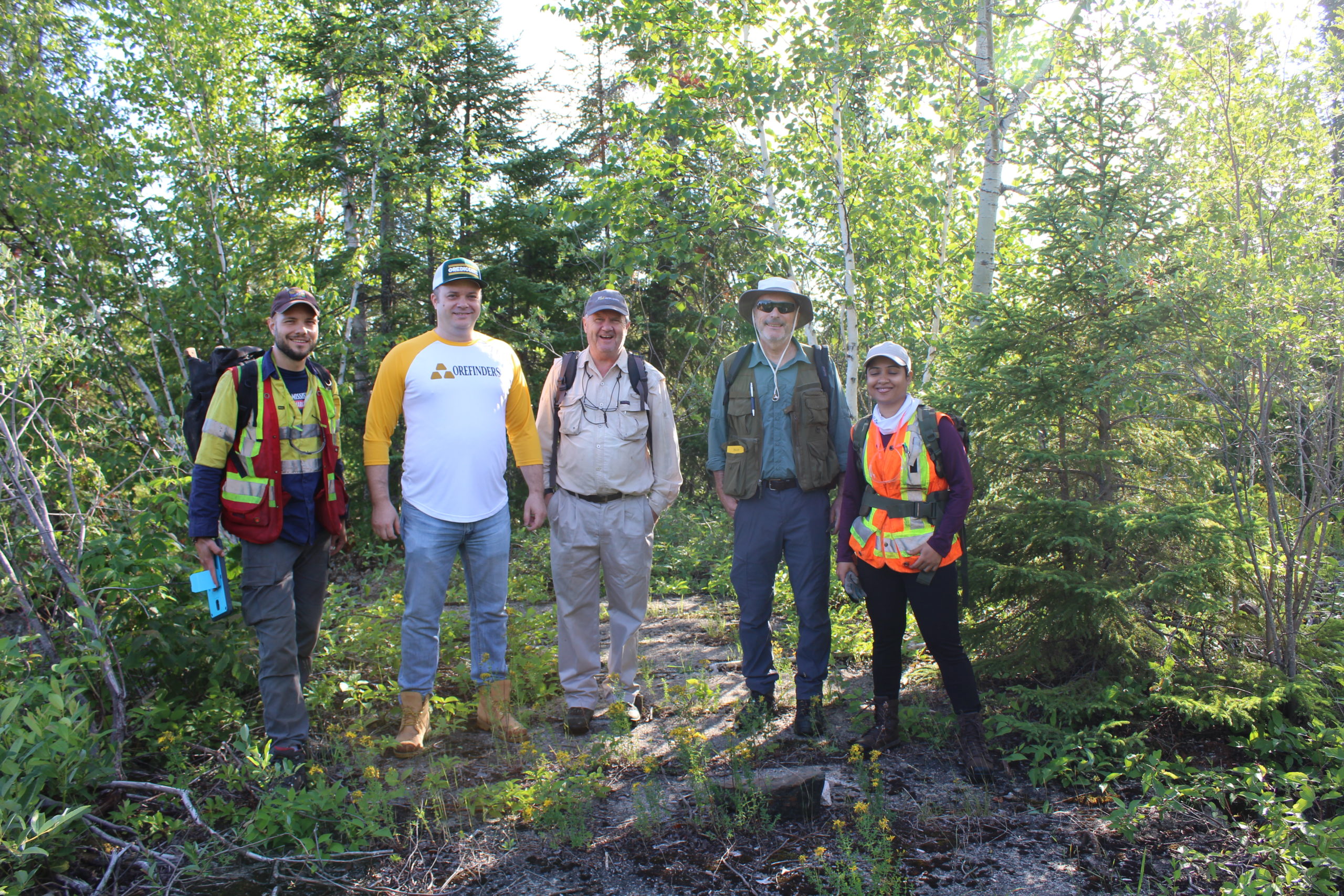
(L to R) Antoine Schwartzmann, Stephen Stewart, Charles Beaudry, Keith Benn, Chitrali Sarkar
Who says mining is not sustainable? The recent announcement by IAMGOLD to start building a C$2 billion Cote Lake open pit gold mine 140 km north of Sudbury which will employ 1,000 workers during peak construction and roughly 450 full-time middle-class jobs is welcome news. The mine life is expected to be around 18 years, however, ongoing exploration may extend the life of mine.
Vale’s Creighton mine which started production in 1901, is still going strong 8,000 feet below surface. The deeper the company goes, the richer the nickel/copper and PGM content of the ore gets. Kirkland Lake’s Macassa gold mine started production in 1933. With new discoveries at deeper levels and a roughly $320 million investment for a new mine shaft, Kirkland Lake Gold’s CEO Tony Makuch is extending the mine’s life for another 30 to 40 years!
Northern Ontario’s mining camps have seen many mines whose lifespans have lasted 50 years or much longer while hundreds of others with shorter operations have still provided tens of thousands of jobs and billions in economic activity for the Ontario economy over the past century.
Meanwhile car manufacturing at Oshawa’s General Motors plant started in 1907 and unfortunately closed in 2018, dealing a devastating blow to southern Ontario’s auto-focused economy. Similarly, in 2011, Ford Motor Company permanently closed its St. Thomas assembly plant that opened in 1967. Now there are rumour’s that Ford may be closing its giant auto assembly plant in Oakville.
This post was originally published last year. A lot has happened in the Ring of Fire since then so I thought I would repost with some updates and interesting links. Some of the most significant developments have been the cancellation of the March 26, 2014 Regional “Framework Agreement” and the election of a new Chief for Eabametoong. On June 17th of this year, Harvey Yesno, former Grand Chief of the Nishnawbe Aski Nation was elected replacing former Chief Elizabeth Atlookan.
Eabametoong is the largest populated community among the five isolated FNs in the Ring of Fire and is also one of the original signatories to Treaty 9 in 1905 along with Marten Falls. I will elaborate on the importance of Treaty 9 in a future update.
Chief Yesno seems to be a very pragmatic, pro-business individual who sees economic development on Eabametoong’s tradiational territories as a way of improving the standard of living in his community. This link https://bit.ly/2wZDqi5 brings you to a previous keynote speech he gave in 2014 while this link is a recent profile in Northern Ontario Business https://bit.ly/2nbGm9v.
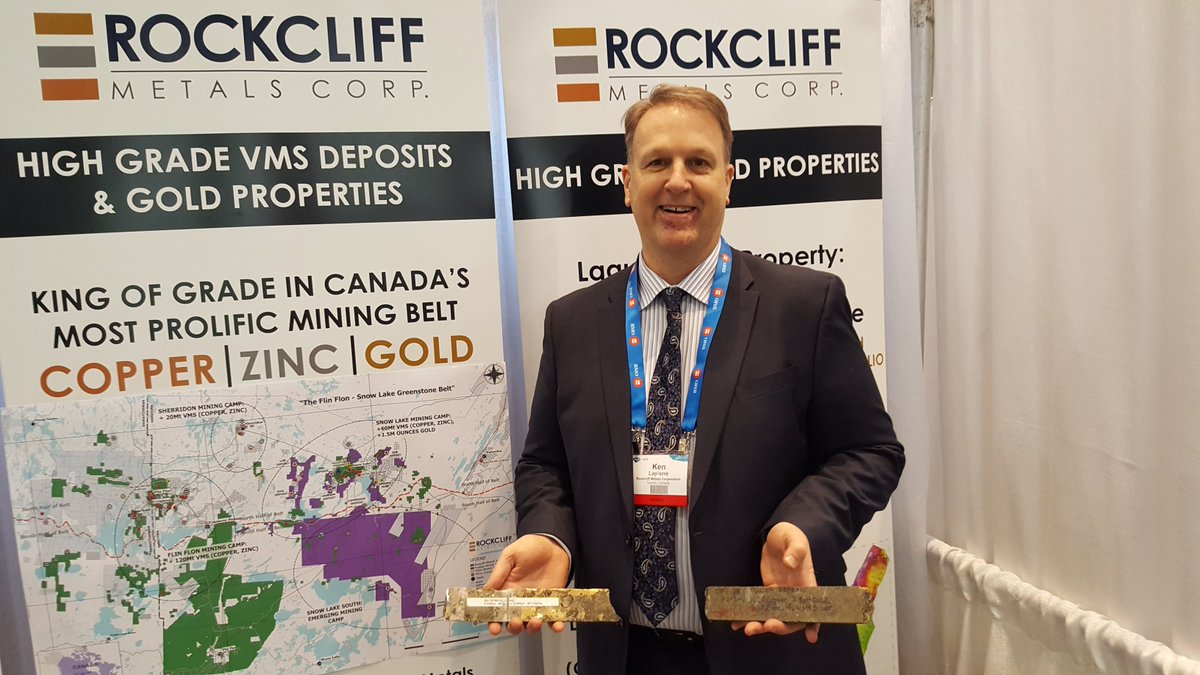
Rockcliff Metal’s founder Ken LaPierre at the 2019 PDAC Mining Convention. A $29 Million financing has turbo-charged junior Rockcliff Metals, which plans to complete over 100,000 metres of exploration drilling over next 18 months. Rockcliff is the 2nd largest landholder in the legendary Flin Flon/Snow Lake greenstone belt in Northern Manitoba after HudBay Minerals. (Photo by Stan Sudol)
Northern Miner
At the Prospectors and Developers Association of Canada (PDAC) convention in Toronto in March 2018, Rockcliff Metals (CSE: RCLF) was a struggling junior with a large land package in the lesser known but geologically rich Flin Flon–Snow Lake (FF–SL) greenstone belt, with eight high-grade, base-metal volcanogenic massive sulphide (VMS) deposits and five gold properties.
It began as a tough year for Rockcliff, and it turned even rougher the week before the PDAC convention, when Kenneth Lapierre, Rockcliff’s president and CEO at the time, slipped on freshly fallen snow when taking out the garbage at home.
Not thinking much about his sore ankle, the six-foot-three-inch, former hockey-playing, karate-practising jock then started shovelling the driveway. Twelve hours later, the swelling and pain in his ankle demanded a trip to the doctor, where he learned that it was broken, and that he had torn all the soft tissue.